Table of contents
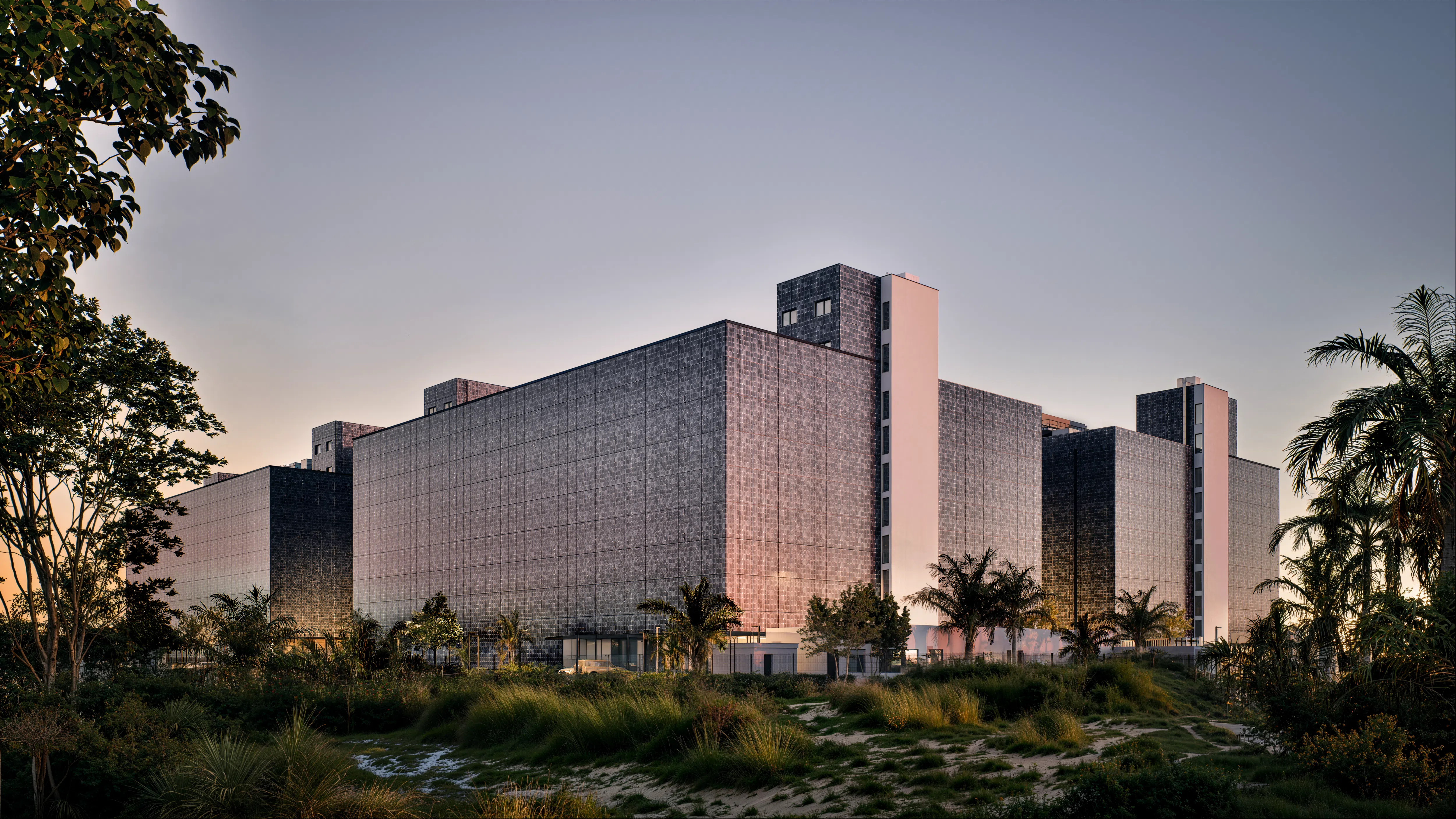
Saudi Arabia is building data center capacity faster than it can lease it. Across NEOM, Riyadh, and the Eastern Province, developers hold powered land and gigawatt ambitions, but a hyperscaler signs for capacity it can evaluate, and a lender funds capacity a tenant has already signed for. A campus that is still a site plan and a power position cannot be walked, and it cannot yet be leased.
A data center digital twin is a real-time virtual replica of a facility. In Saudi Arabia the term is used three ways: a national or urban twin that models cities and infrastructure for planning, an operational twin that runs a live facility through sensors, and an experiential twin, a walkable real-time model developers use to pre-lease capacity and reach financial close before construction. This guide covers the third, the one that leases and funds a NEOM-era site.
The distinction matters more here than almost anywhere, because the Kingdom is pouring capital into sites years ahead of the tenants who will fill them, and the twin that closes a lease is not the twin that runs the room.
What Is a Data Center Digital Twin, and What Does It Mean in Saudi Arabia?
A data center digital twin is a virtual model of a facility kept faithful to the real thing, updated with data so it mirrors the physical site rather than sitting static like a drawing. In Saudi Arabia the word now carries a local weight most markets lack, because the Kingdom has made digital twins national infrastructure, so naming the kind you actually need is the first step.
In practice the term points to two twins a developer does not commission:
- A national or urban twin. Saudi Arabia has adopted a national digital twin platform as a governance standard for modeling cities, utilities, and assets.
- An operational twin. At the facility scale, industrial and operational twins run live plants through sensors and analytics.
Both are engineering and governance instruments, and both are what most search results for this term describe.
A data center developer before ground-break needs neither. There is no live plant to monitor, no city grid to govern. There is a site, a power position, a set of drawings, a leasing target, and a financing deadline. The task is to make a hyperscaler and a Vision 2030 investor believe in a campus that does not exist yet. That is a third kind of twin, the experiential one, built to close capacity and raise capital rather than to run or govern anything.
How to Tell Saudi Arabia’s National, Operational, and Experiential Digital Twins Apart
Three twins share the name and do three different jobs. A national or urban twin models cities and assets for planning and governance. An operational twin syncs with a finished facility to run it. An experiential twin lets tenants and investors walk a campus to commit to it before construction. Asking one to do another’s job is the most common and most costly mistake a developer makes on this term.
The table separates them on the terms that decide which one a Saudi developer actually commissions.
| National / urban twin | Operational / DCIM twin | Experiential / leasing twin | |
|---|---|---|---|
| Job | Model cities, utilities, and assets for planning | Monitor and run the live facility | Lease and finance the campus before construction |
| Primary users | Government, planners, utility operators | Facility, operations, and capacity teams | Hyperscaler site-selection teams, investors, the leasing team |
| What it models | Urban systems, land, infrastructure | Live power, cooling, and capacity per rack | The campus, powered shell, suite, and power story, shown at real scale |
| When it is built | Ongoing, at national scale | After the building is operational | Preconstruction, for the leasing window |
| Underlying tech | Geospatial platforms, IoT, national data | DCIM sensors, live telemetry, CFD | CGI plus a real-time engine walkthrough, pixel streaming |
| KSA example | The national digital twin standard | Facility DCIM at a live campus | A walkable twin of a NEOM-era campus for leasing |
This guide owns the third column. The first is national infrastructure, the second is built years later once the facility runs. The general data center digital twin guide draws the same operational-versus-experiential line for the global market, and the 3D data center visualization pillar covers the leasing thesis in full. The experiential twin sits beside the operational and national stacks, not inside them. It makes the campus legible to the people who lease and fund it, and it does not pretend to simulate or govern anything.
Why NEOM-Era Data Centers Have to Sell Capacity Before They Break Ground
Because the capacity is being committed years ahead of the tenants and the money. The Saudi data center market is climbing from about USD 2.91 billion in 2026 toward USD 8.85 billion by 2034, a 14.93% compound annual rate (IMARC Group, 2026), and the flagship campuses are announced as gigawatt commitments long before they energize.
The headline projects set the pace, each committed as capacity years before it energizes.
- DataVolt and NEOM: a USD 5 billion agreement to build a 1.5 GW net-zero AI campus in Oxagon, powered entirely by renewable energy, with phase one expected to operate in 2028; (Data Center Dynamics, 2026).
- HUMAIN, the Public Investment Fund’s AI company: targeting roughly 6.6 GW of capacity over the decade, with a USD 1.2 billion package arranged with the National Infrastructure Fund to build 250 MW.
- stc’s center3: targeting 1 GW of capacity by 2030.
- Vision 2030: projects across the Kingdom have reached about USD 1.3 trillion in value (Gulf News, 2026).
Those numbers describe a market that reserves capacity before it pours concrete. In that market, the developer who can show a campus earliest wins the anchor tenant earliest, and the campus that cannot be shown waits. An experiential twin is how a site becomes visible to a hyperscaler and a fund while it is still a field, a substation, and a set of drawings.
How to Use a Digital Twin to Pre-Lease Capacity to Hyperscalers and Vision 2030 Investors
You give each audience a version of the campus they can evaluate before it exists. A hyperscaler’s site-selection team walks the powered shell and their future suite at real scale. A Vision 2030 investor sees the whole campus set against its power and connectivity story. The leasing team carries one consistent asset from the first meeting to a signed lease, so the argument never resets across the months a Gulf deal takes.
The twin carries that argument through a deliberate sequence.
- A cinematic pass opens the first conversation with a tenant or a sovereign-linked investor, the campus set against its renewable power and subsea-cable connectivity.
- The interactive walkthrough is where interest turns concrete: the tenant navigates the powered shell and their own hall, and reads the white space, the ceiling heights, and the routes for power and cooling.
- The digital sales gallery closes it: available suites, megawatts, the site plan, and status on one link, tied to a CRM so the team sees who is reviewing which hall and when they are ready to sign.
This is where the Saudi audience mix matters. The people evaluating a NEOM-era campus are rarely in the same room, or the same country:
- A hyperscaler’s site-selection team, choosing a location on power, timing, and design.
- A PIF-backed or sovereign-linked investor, underwriting the campus as an asset.
- HUMAIN or a similar sovereign AI buyer, sizing capacity for a national AI program.
- The site-selection advisors and consultants who screen the shortlist.
None of them will fly to a desert site to read a PDF. A twin they can open from Riyadh, Davos, or Seattle is the campus tour that closes the gap between a land-and-power position and a signed commitment.
How to Use a Digital Twin to Pre-Lease Capacity to Hyperscalers and Vision 2030 Investors
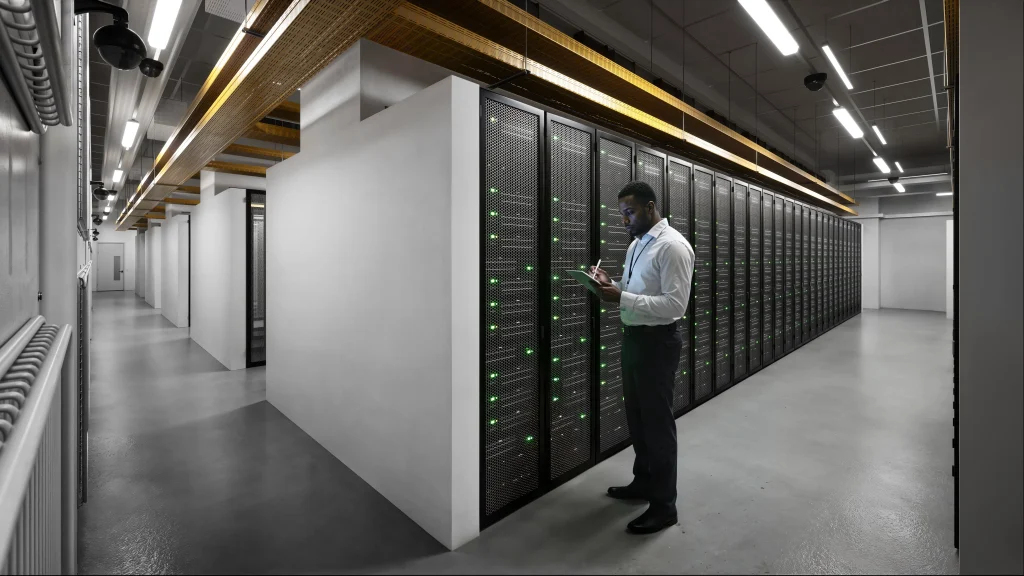
You give each audience a version of the campus they can evaluate before it exists. A hyperscaler’s site-selection team walks the powered shell and their future suite at real scale. A Vision 2030 investor sees the whole campus set against its power and connectivity story. The leasing team carries one consistent asset from the first meeting to a signed lease, so the argument never resets across the months a Gulf deal takes.
The twin carries that argument through a deliberate sequence.
- A cinematic pass opens the first conversation with a tenant or a sovereign-linked investor, the campus set against its renewable power and subsea-cable connectivity.
- The interactive walkthrough is where interest turns concrete: the tenant navigates the powered shell and their own hall, and reads the white space, the ceiling heights, and the routes for power and cooling.
- The digital sales gallery closes it: available suites, megawatts, the site plan, and status on one link, tied to a CRM so the team sees who is reviewing which hall and when they are ready to sign.
This is where the Saudi audience mix matters. The people evaluating a NEOM-era campus are rarely in the same room, or the same country:
- A hyperscaler’s site-selection team, choosing a location on power, timing, and design.
- A PIF-backed or sovereign-linked investor, underwriting the campus as an asset.
- HUMAIN or a similar sovereign AI buyer, sizing capacity for a national AI program.
- The site-selection advisors and consultants who screen the shortlist.
None of them will fly to a desert site to read a PDF. A twin they can open from Riyadh, Davos, or Seattle is the campus tour that closes the gap between a land-and-power position and a signed commitment.
How to Turn a Digital Twin Into Financial-Close Proof for Lenders and Sovereign-Backed Capital
Because in a Saudi data center deal the anchor lease is the security behind the whole capital stack. Lenders underwrite contracted cash flows, not market forecasts, and an anchor tenant covering 60 to 80 percent of day-one capacity is the single largest determinant of whether a project can be financed(Consultancy-ME, 2026).
The Kingdom already has the worked example. The DataVolt Riyadh East facility reached financial close after securing HUMAIN as an anchor customer for 82 percent of capacity, which let banks fund roughly three-quarters of the project cost(Consultancy-ME, 2026). At a global benchmark near USD 11 to 14 million per megawatt, a gigawatt of announced Saudi capacity implies tens of billions in capital, and none of it moves until an investment-grade or sovereign-linked tenant signs. The anchor comes before the finance, and the twin is what helps win the anchor.
That reframes what an experiential twin is for. It is not a marketing expense on a data center pro forma. It is the instrument that helps engineer a capital event, by getting the anchor tenant that de-risks the debt and the equity signed earlier. An investment committee or a project-finance desk that can walk the campus, read the power position, and see the tenant’s own hall before the pour is a committee that moves sooner than one reading a slide.
How to Build an Experiential Twin From Your Existing Design Model
You do not rebuild the campus. You translate the Revit, IFC, or CAD model your engineers already hold into a real-time engine a tenant can navigate, then keep it faithful to the design as it evolves. The engineering geometry is the base, and the work is turning it into visual truth, real scale, and interactivity. The steps below run from your existing files to a streamable walkthrough.
- Start from your existing geometry. A Revit model, an IFC export, or an early massing set is the base. An existing model shortens the build, and the 3D data center model guide covers the full CAD-to-visualization pipeline step by step.
- Optimize for real time. Engineering geometry is heavy and built for accuracy, not frame rate. Clean and decimate dense assemblies, and strip hidden detail while keeping hall volume, ceiling heights, white space, and containment.
- Import into a real-time engine. Datasmith brings Revit, 3ds Max, SketchUp, Rhino, and common CAD formats into Unreal Engine while preserving hierarchy, materials, and metadata(Epic Games, 2026), the bridge from a static file to an interactive scene.
- Material, light, and make it navigable. Physically based materials and real-time global illumination turn the model into a first-person space walked at real scale, with hotspots for the power, connectivity, and density story.
- Keep it synchronized. What makes it a twin rather than a one-off render is that it updates with the design. As the powered-shell layout, suite mix, or capacity changes, the walkthrough is revised from the same source, so the asset a tenant sees always matches the campus being built.
- Stream it anywhere. Pixel streaming runs the engine in the cloud and delivers the walkthrough to a browser link, so a tenant’s committee in Riyadh or abroad opens it on any device with no install, on screen or in a headset.
Run these from one model and every deliverable stays consistent by structure. The campus a tenant sees in the film is the campus they walk in the gallery, because both come from the same twin, not three vendors reconciling three files.
How to Show Power, Cooling, and Density Without Claiming to Run the Site
Show the infrastructure story, not the simulation. An experiential twin makes the power path, the cooling design, and the rack density legible so a tenant’s engineers can read the deployment they need, and in Saudi Arabia the power story is often the strongest part of the pitch. A NEOM campus that visualizes a dedicated gigawatt of secured renewable power answers the first question a serious hyperscaler asks.
That legibility earns commitments, because power and density decide these deals. A leasing-grade twin makes three things legible to a tenant’s engineers:
- Power: the substation, the interconnection, and the on-site renewables. In Oxagon that story is a dedicated 1.5 GW of renewable energy and Red Sea connectivity(NEOM, 2026), a secured, ready-to-energize case worth more in the Gulf than any render of a lobby.
- Cooling: the liquid-cooling design the hall is built around, which the desert climate and rising AI density make non-negotiable.
- Rack density: the AI-ready hall itself. Average rack power has climbed to about 27 kW in 2026, the newest platforms reach up to 246 kW per rack, and only about one in five operators say they are ready for the 50–70 kW racks now common in AI deployments(Schneider Electric, 2026).
The scope line is exact, and stating it is part of the credibility. Computational fluid dynamics, thermal analysis, and live capacity management belong to the design and operational twins, the DCIM and simulation platforms built for a different job at a different stage. The experiential twin visualizes the design those tools validate so a tenant’s engineers can read it. It does not simulate the building, and a partner who claims it does is overselling.
Where Fortes Fits: The Experiential Twin, Built in One Studio for Gulf Developers
Fortes Marketing builds the experiential and pre-lease layer as one studio, in-house, so data center developers courting hyperscalers and Vision 2030 investors can lease capacity and raise capital before the slab is poured. The interactive real-time Unreal Engine walkthrough is that experiential twin, an engine-driven model a tenant or investor navigates before construction, on a screen or in a headset such as Meta Quest 3, produced alongside the photoreal CGI, the cinematic film, the leasing gallery, the developer website, and the brand that ties them together. It is the one studio that replaces three vendors: a CGI studio, a web agency, and a branding designer.
The mechanism is what makes the speed possible. Because the renders are produced in-house, the digital sales gallery is built from the same model, so the campus a tenant sees in the CGI is the campus they walk in the twin, and consistency is structural rather than a coordination cycle. The starting point is the geometry you already own: when a developer supplies a 3D model, Fortes integrates it at a lower rate than building from nothing, so the path from CAD to a leasing asset is faster the more you bring. What Fortes delivers is the walkable twin, the film, and the leasing gallery, typically in 5 weeks for the gallery, as one pre-construction marketing system rather than a stack of separate contracts.
On scope, Marketing.Fortes.Vision is exact. It builds the experiential and marketing layer, not operational DCIM, and there is no CFD, thermal, power, or cooling simulation here. A data center developer needs both layers, from different providers, for different reasons. Pricing is scoped to the campus, at higher-end production quality on a mid-market budget. As a reference:
- Campus CGI views: typically start around $1,200–$2,500 each.
- Additional angles within an existing scene: around $450–$540 each.
- The interactive real-time walkthrough, the experiential twin: from about $20,000 for a single building into six figures for a large complex.
- A supplied 3D model: integrated at a lower rate than building the geometry from nothing.
Exact numbers depend on the campus, the asset set, and how much of your own model you bring.
The twin that leases and funds a Saudi data center is not the one that runs it or the one that governs the city around it. It is the one a hyperscaler can walk and a Vision 2030 investor can underwrite, built before the concrete is scheduled and kept faithful to the campus you are still designing.