Table of contents
Here’s how branding usually goes on a development. The signage is about to go up, so someone asks a designer for a logo, and that’s branding handled. But by then the renders are finished, the website is half-built, and the bank wants proof the project will sell before it releases the construction loan. A logo can’t carry that on its own. Real estate development branding is what makes a project sellable before it exists, and it has to start on day one, not at launch.
Real estate development branding is the strategic and visual system that gives a pre-construction project an identity buyers can understand, trust, and act on before the building is real. It covers the position the project owns, its name and story, and the design language that expresses them: the logo, typography, color, tone of voice, and CGI style, carried consistently across every render, the sales gallery, the website, and the brochure.
What Is Real Estate Development Branding, and Why Does It Matter Before Construction Starts?
Real estate development branding is the identity a project carries before it has a lobby to walk through or a unit to tour. It decides how a buyer reads the project from a name, a render, and a story, which are the only things that exist at presale.
Branding earns its budget because a pre-construction sale is a sale of belief. The buyer commits money to a promise, and the brand is what makes the promise credible. Buyers check the developer before they sign, and a consistent brand gives them the answer they look for: a clean website, consistent renders, and a name brokers recognize. That trust is what turns interest into signed contracts.
That is not a perception argument alone; it shows up in price. Branded residences, the clearest case of a name doing commercial work, command a global average price premium of 33% over comparable unbranded stock, rising to 39% in resort markets (Savills, Branded Residences 2025/26).
Why Do Most Developers Treat Branding as an Afterthought, and What Does It Cost Them?
Most developers delay branding because the building feels like the product and the brand feels like decoration. The cost of that order is a project that reaches the market with renders and a PDF but no story that makes a buyer choose it over the development down the road.
This is the sales-execution gap. The developer has the vision and the renders but lacks the identity and sales infrastructure that convert that vision into reservations. When the brand arrives late, the project pays in the metric that matters for its type: for a community, a late brand slows sell-through; for a high-rise, it drags on absorption rate; for a luxury project, it surfaces as concessions at the negotiation table.
A brand set early pays back three ways: sell-through speeds up, prices hold instead of sliding into discounts, and the cost of reaching a qualified buyer drops. The financing angle sharpens all three. A lender releases the construction loan on presale evidence, meaning binding reservations rather than a logo, so the brand’s real job is to generate those reservations before ground breaks.
How Do You Find a Position Only Your Project Can Own?
Positioning is the choice of the one idea your project can claim truthfully that no competitor nearby can. It comes before the name and the logo, because every later asset either expresses that position or dilutes it.
A workable position sits at the overlap of five inputs:
- Emotional territory: the feeling the brand carries.
- Audience: the segments you serve and the job the buyer hires the home to do.
- Competitors: what rivals claim, and the white space they leave open.
- Market: local trends, pricing, and demand.
- Product: the substance and scale of what you are actually building.
Where those five overlap is the brand essence: what is true and differentiated about the project. All the data informs; the overlap reveals. A position built this way turns a marketing budget into recognition: buyers remember the project and its brand assets, and that memory shortens the path to a reservation. Get the position right and the rest is promotion.
How Do You Name a Real Estate Development?
You name a development by working from research to a shortlist to due diligence, not by brainstorming words in a room. The name has to reflect what you want a resident to feel, survive a legal and domain check, and stay usable in every market where a buyer will search for it.
A process that holds up across US, UK, and Gulf projects runs in six steps:
- Start from the brief and the place. Gather everything about the site: location, specification, audience, and what makes it different. Then study the surroundings for landmarks, heritage, and local detail worth naming around.
- Pick two or three creative routes. One route might draw on the architecture, another on local history, another on a feeling; explore a few directions before you commit to one.
- Build a longlist, then cut hard. Draft 20–30 candidates and narrow to a shortlist of about 10, each with a short rationale a stakeholder can weigh.
- Run due diligence before you fall in love. Search the trademark register that applies: USPTO in the US, the IPO in the UK, the relevant authority in the GCC. Then check domain availability and scan for a nearby development, hotel, or business already using a similar name.
- Check the name across languages. A name that reads well in English can misfire in Arabic transliteration, and the reverse; in bilingual Gulf markets this step is not optional.
- Test, then adopt and protect. Put the shortlist in front of the audience or the stakeholder group, choose the name, then secure the domain and the trademark before you announce.
Most names follow one of four routes: place-led (a neighborhood or landmark), heritage-led (the site’s history), evocative (a coined or emotional word, the way Serenbe fuses serenity and being), or descriptive with an extension such as Residences, Gardens, or Flats that signals the product type. Whichever route you take, the name is where positioning becomes a single word, so it has to earn its place against the position, not against a room’s favorite pun.
What Are the Core Elements of a Development Brand Identity?
A development’s visual identity is the system that expresses its position everywhere a buyer meets the project. It is not a logo alone; it is the logo, typography, color, tone of voice, and image style working as one, built to stay consistent from a construction hoarding to a phone screen.
- Logo: the mark that repeats from signage to a favicon. Test it at every scale so it stays legible when small.
- Typography: gives the project a voice, with a hierarchy held consistent across print, web, and signage.
- Color palette: drives subconscious association; build a core and an extended set so the brand flexes into UI, alerts, and backgrounds.
- Tone of voice: the copy does as much work as the visuals, so lock three to five tone cues and the brand sounds the same from the website to a broker email.
- Look and feel, the CGI: at presale the renders are the product, so the identity has to reach into them. Photography, video, and CGI need one art direction, or the sales tool contradicts the brand.
- Graphic and layout system: patterns, icons, and grids kept modular, so the brand grows cleanly from phase one to phase three.
A development now lives inside a screen before it lives on a street. Buyers form a verdict from a website, a digital brochure, and a 3D tour long before a sales office exists, so the identity has to be built for digital from the start, not adapted to it later. The payoff of getting this right is one visual language across every asset, and consistency reads as low risk on a purchase this size, while vendor drift reads as risk.
What Does a Development Brand Look Like in Practice?
The test of a project brand is whether one position carries through every asset and solves a real product problem. Two developments show the pattern: a position chosen first, then pushed into the renders, the landscape, and the buyer’s experience until brand and product read as one thing.
The Preserve at the Woodmere Club: A Position That Fixes the View
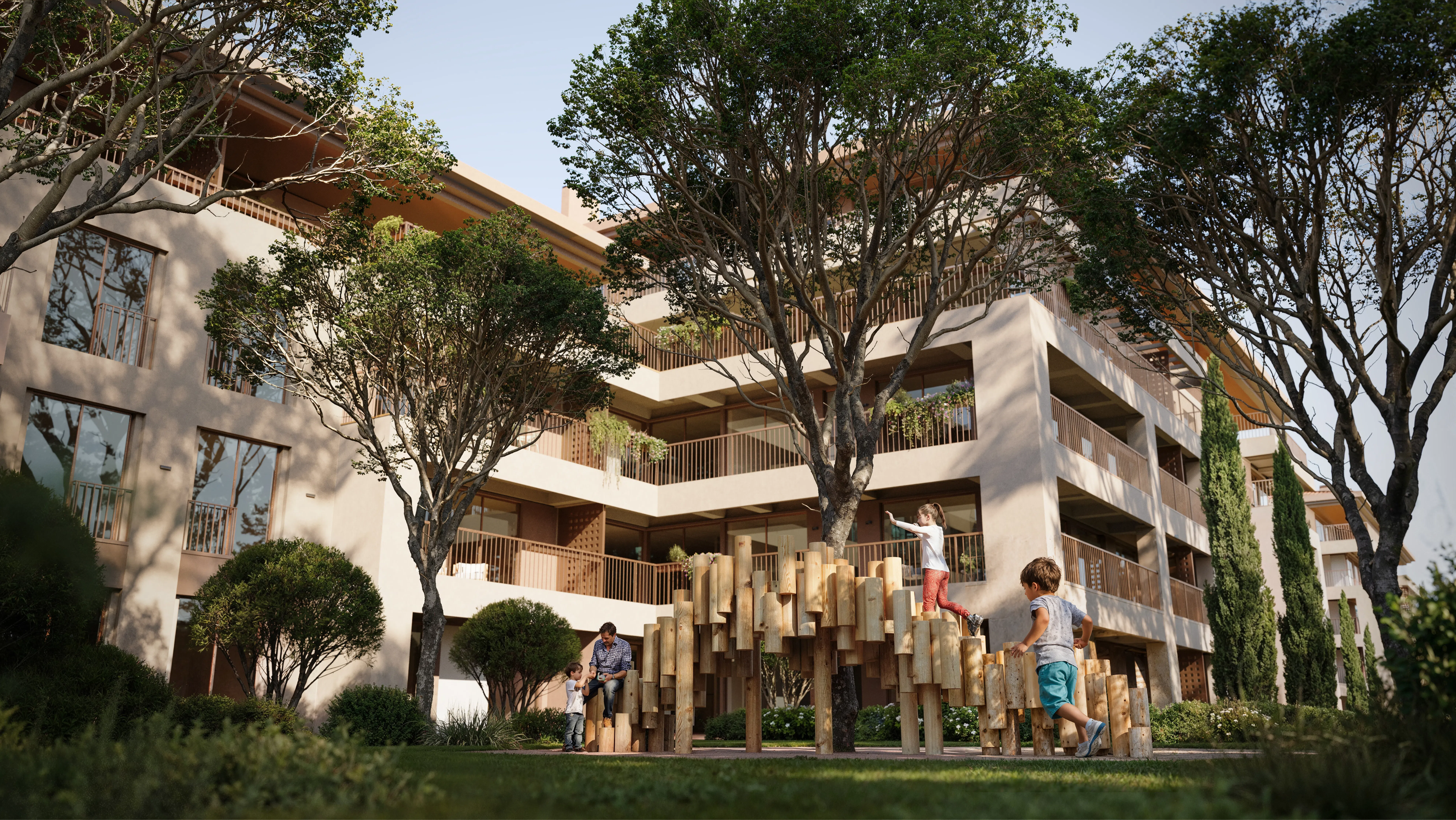
The Preserve is a 55+ condominium community of roughly 150 residences on the former Woodmere Club grounds in Five Towns, Long Island. Its position, “Stay Rooted,” speaks to longtime residents downsizing into resort-style living without leaving the community they built their life around, under the tagline “Keeping what matters close.”
The brand idea is roots, and it was made physical. Some balconies looked onto a plain view that did not show the brand, so plants were added to the balcony renders and the real landscape: lavender, mugo pine, juniper, lemon balm, and ferns, chosen for a 55+ audience. One decision solved the marketing problem and the product problem at once: the renders read warm and full, and the finished balconies match them.
Nele: One Position That Answers Every Objection
Nele is a boutique 8-residence Altbau renovation with rooftop penthouses in Vienna, positioned on the seam between the creative 7th district and the intellectual 8th. The site had no on-plot parking and limited greenery, and the position turned both into non-issues: in a city people choose for the city itself, the neighborhood becomes the amenity, so a car matters less when both districts open at the doorstep, and a private garden matters less when the city’s parks, cafés, and galleries work as an extended living room.
The idea even reached the welcome box, a map of both districts with gift cards to local cafés and galleries, handing buyers the city as a curated experience. The lesson holds for any project: one strong position makes a product’s weaknesses irrelevant, where a scatter of separate excuses never would.
How Does Real Estate Development Branding Differ Across the US, UK, and Gulf Markets?
The craft is the same everywhere: position, name, identity, and consistency. What each market rewards differs sharply. A US project sells belief in a lifestyle, a UK project increasingly sells a place and a managed rental brand, and a Gulf project sells an off-plan promise at national scale, often in two languages.
| Dimension | United States | United Kingdom | Gulf (Saudi Arabia & UAE) |
|---|---|---|---|
| What the brand mainly sells | Lifestyle and belonging | A place and a managed rental brand | An off-plan promise at giga scale |
| Dominant branded format | Branded residences (hotel and lifestyle) | Build-to-Rent and student housing | Off-plan launches and branded residences |
| Buying moment | Mostly for-sale, at or near completion | Rental lease-up; some for-sale | Off-plan reservation before construction |
| Naming context | English; state-by-state trademark scan | English; UK IPO and domain diligence | Bilingual Arabic and English; transliteration matters |
| Signal that sets the bar | A large national branded-residence pipeline | Portfolio-level operator brands | Government-backed masterplans and giga-projects |
United States: Branding Sells a Lifestyle, and the Badge Sells a Premium
North America leads the branded-residence world, with 260 completed schemes and 116 more under development, and 37 of the 50 states now host at least one (Knight Frank, Global Branded Residence Survey 2025). South Florida alone ended 2025 with 48 completed branded projects and 55 in the pipeline. The takeaway for a US developer: buyers increasingly expect a home to behave like a brand, an effect often called the “hotelification” of real estate, and a clear lifestyle position is what defends price in a market where builders lean on discounts and mortgage-rate buydowns.
United Kingdom: Branding Sells a Place and a Rental Operator
The UK’s development-branding engine is rental. Build-to-Rent investment reached a record £5.3 billion in 2025, with more than 146,700 completed BTR homes and over 100,000 more in the planning pipeline(Savills, UK Build to Rent 2025). That shifts the brand’s job from a single sale to a durable, portfolio-level identity that has to earn renewals and carry across a district. That is why UK naming leans on placemaking, neighborhood extensions, and operator brands a resident lives inside for years, in both Build-to-Rent and purpose-built student accommodation.
Gulf (Saudi Arabia and the UAE): Branding Sells an Off-Plan Promise at National Scale
In the Gulf, most homes sell before they exist. Off-plan reached 72% of all Dubai residential transactions in 2025, up from 68% a year earlier (Savills, Dubai Residential Market 2025). At that point the brand and the renders are the entire product, so an escrow-backed off-plan launch lives or dies on how convincingly the project is visualized and named.
Scale raises the stakes again in Saudi Arabia. Under Vision 2030 and a 70% homeownership target, the Kingdom needs an estimated 825,000 new homes by 2030, and giga-project contract awards climbed 20% to $196 billion in 2025 (Knight Frank, The Saudi Report 2025). Masterplan names like NEOM, Diriyah, and Roshn now function as national brands, and a developer building near them brands bilingually, for an Arabic-reading and an English-reading buyer at the same time.
How Do You Build a Development Brand Without Managing Three Vendors?
Most developers assemble a brand from three separate vendors: a CGI studio, a web agency, and a branding designer. Then they spend the schedule reconciling the outputs. The alternative is one studio that produces the renders, the sales gallery, the website, and the brand identity as a single engagement, so the brand is consistent by construction rather than by revision.
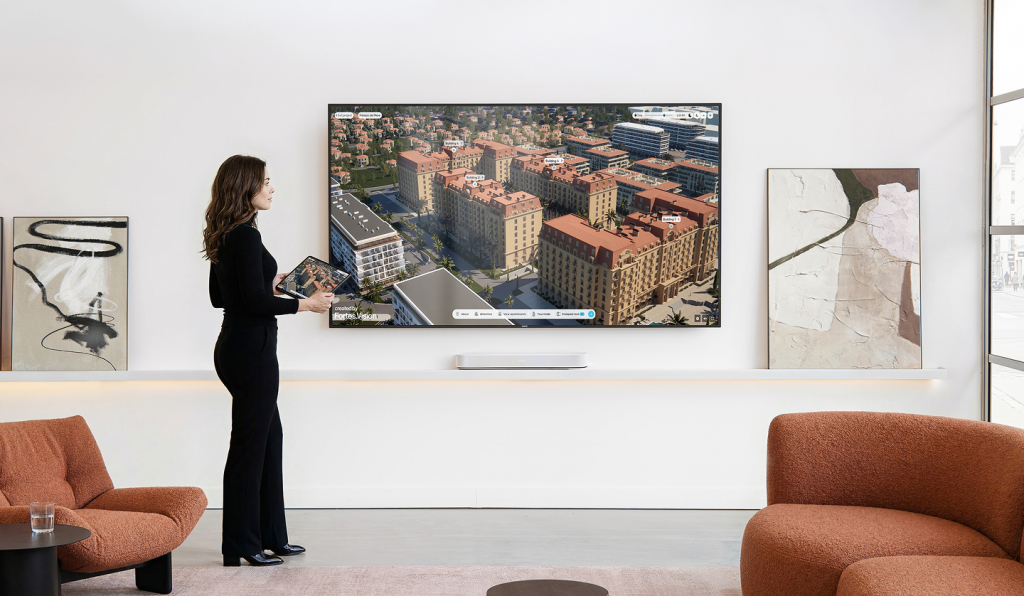
That is the model Marketing.Fortes.Vision runs. Fortes is the pre-sale marketing studio that delivers a developer’s full pre-sale stack as one engagement: in-house CGI renders, an interactive digital sales gallery, a developer website, and the brand identity that ties them together. It is the one studio that replaces the three vendors. Because the CGI is produced in-house, the brand reaches into the renders directly, so there is no gap between the identity and the sales tool a buyer actually explores.
Marketing.Fortes.Vision treats brand as the cohesion layer, not the opening product. The gallery and the website are the commercial execution layer, the assets that close buyers and record the reservations a lender wants to see, and the brand is what makes them read as one project. The studio learns the audience and the location, then defines the project’s DNA positioning, tone of voice, and identity from there.
The digital sales gallery is delivered in about 5 weeks, so a developer can brand, build, and test the sales experience before launch rather than after. For a single building, a package of renders, brand, and sales assets typically starts around $10,000–$30,000 and scales with the size of the project and the stack, with exact scope quoted per project. Bought as one engagement on a fixed timeline, the brand lands when the reservations that unlock financing are due, not weeks after the window closes.