Table of contents
A real estate developer is the only kind of seller who has to close the deal before the product exists. There is no model home to walk and no finished unit to tour, only a site, a set of drawings, and a construction loan that will not release until enough buyers commit to floors of a building that is currently a fenced lot with a crane on it.
Selling the invisible is the whole job, and it is not advertising you switch on a month before launch. It is a system: the renders, the digital sales gallery, the developer website, and the brand that together turn a project no one can see into signed contracts. This guide explains how that system works, the seven strategies that drive it, and the companies that build it, so you can reach the presale threshold your lender is waiting on before you break ground.
Real estate development marketing is the system a developer uses to sell units in a project before it is built. It combines CGI renders, a digital sales gallery, a developer website, and a project brand to turn buyer interest into binding contracts, and to give a lender the presale evidence it needs to release the construction loan.
What Is Real Estate Development Marketing?
Real estate development marketing is the work of creating demand for a building that does not exist yet and converting that demand into binding contracts. It is revenue engineering, not lead generation: the point is signed presales and the evidence a lender needs, not clicks on a listing.
It runs across the whole project life, from positioning 12 to 24 months out, through pre-sales and construction, to close-out. Every phase carries one job, moving a buyer closer to a contract and moving the project closer to the presale threshold that unlocks financing. The developer sells the story of the building first, then builds it with the buyers’ deposits and the bank’s money.
That is a different discipline from marketing a finished home, and treating the two as the same is where most budgets go wrong.
How Is Marketing a Development Different From Selling Finished Real Estate?
Selling a finished home is a sprint against comparable listings; marketing a development is a multi-year job to sell something with no walls yet, on a clock the construction loan sets. One lists an asset that exists. The other builds demand and a brand for one that does not.
Three parties carry the risk of a presale, and each bets on the same thing, how well the project is sold before it exists. The developer builds with deposits and financing instead of their own capital alone. The buyer commits at a pre-construction price and pays in stages. The bank wants proof of real demand, as binding contracts, before it funds construction. The table below shows where the two jobs diverge.
| Dimension | Selling Finished Real Estate | Real Estate Development Marketing |
|---|---|---|
| What you sell | An asset a buyer can walk through | A vision: renders, a gallery, and a brand |
| When the sale closes | After the product exists | Before construction, often before groundbreaking |
| What the buyer evaluates | The physical unit and the comps | The visualization and the developer’s credibility |
| Timeline | Weeks to months | 12 to 24 months, tied to the build |
| The gatekeeper | The buyer’s mortgage lender | The developer’s construction lender |
| The core asset | The listing | The digital sales gallery and developer website |
| Success metric | Days on market, sale price | Absorption rate and the presale threshold |
The practical takeaway is that a development cannot borrow the finished-home playbook. There is no unit to stage, so the visualization is the unit. There is no buyer’s-agent lender to satisfy at the end, so the construction lender’s presale threshold governs the whole schedule from the start.
What Are the Four Parts of the Pre-Sale System?
The pre-sale system has four parts that build on each other: the CGI renders, the digital sales gallery, the developer website, and the project brand. Each does a specific commercial job, and each is worth little without the others. Renders with nowhere to convert are a portfolio; a website with no sales tool is a brochure.
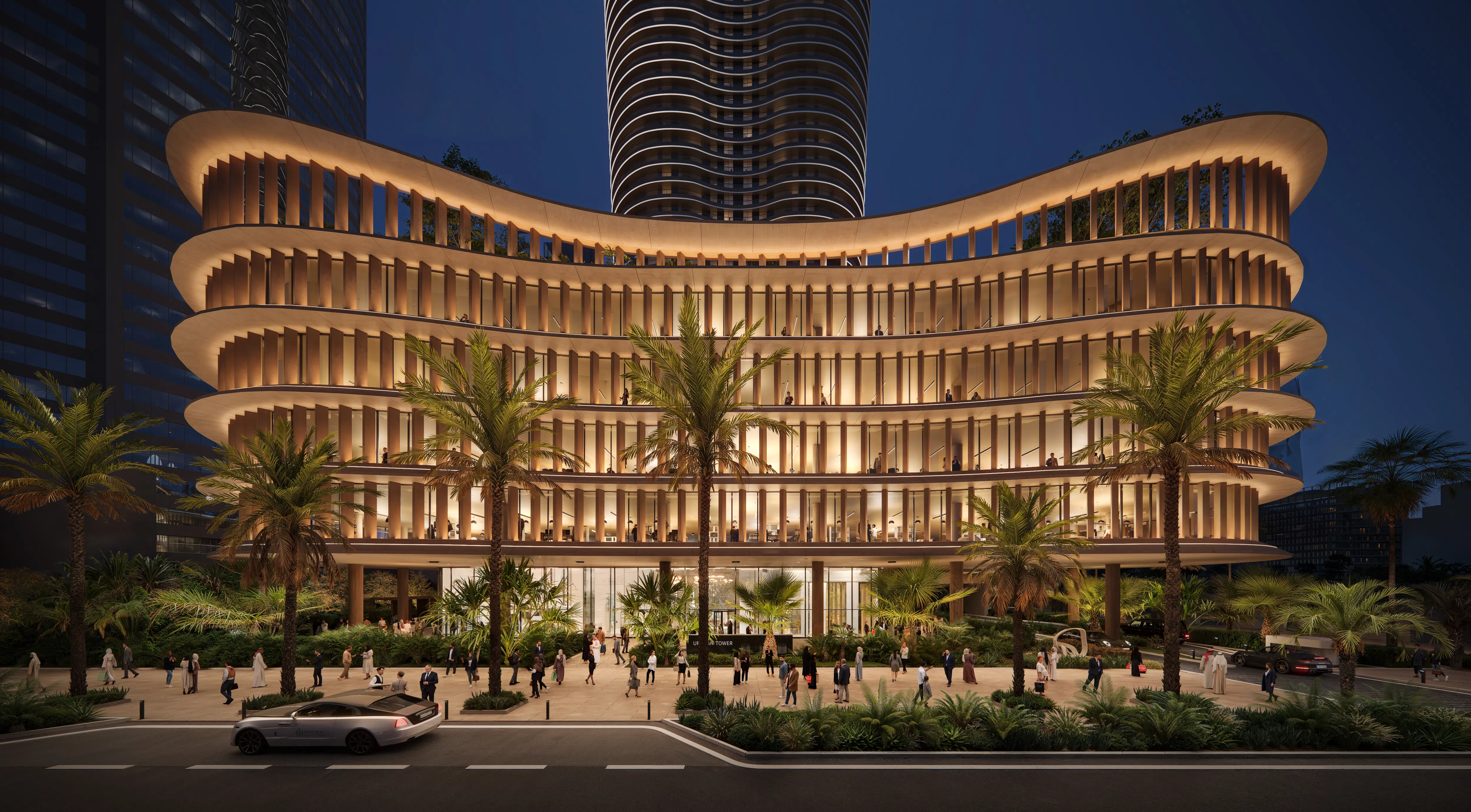
CGI renders are the product itself. When the building does not exist, a buyer spending seven figures judges exterior views, interiors, amenities, and the view from a specific floor entirely through visualization. The renders are not decoration; they are the only version of the unit a buyer can experience.
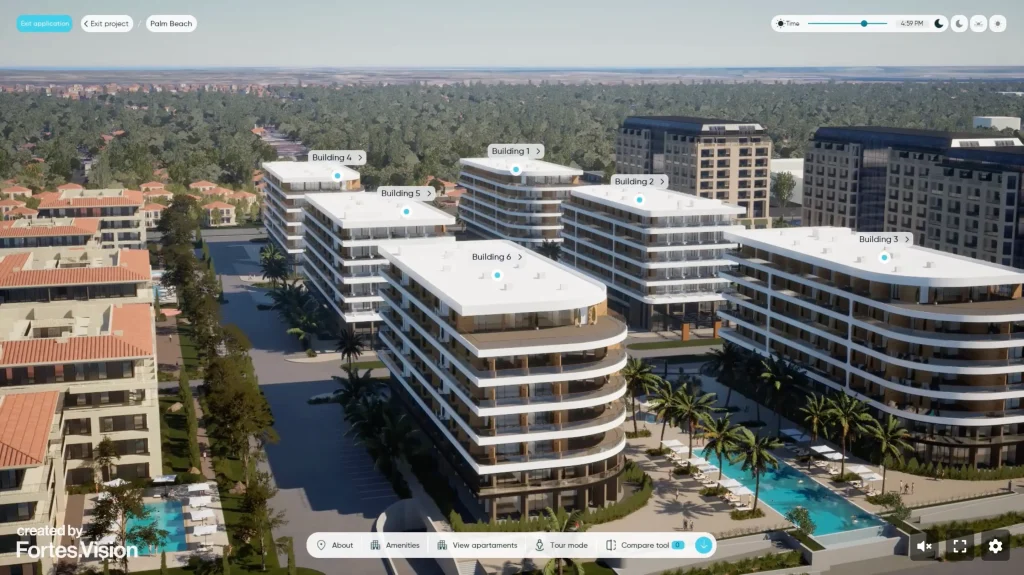
The digital sales gallery is where interest becomes commitment. A digital sales gallery lets a buyer explore a floor plan, choose a specific unit, see the view from its real orientation, and move through the space before any of it is built. One link carries the renders, animation, a virtual tour, unit selection, and the brochure, so a broker sends it ahead of a meeting and the buyer arrives ready to reserve.
The developer website is the hub the gallery lives in. It is the conversion engine that houses the gallery, the availability, and the story, and it is where paid and broker traffic lands. A developer website built alongside the renders holds one visual language from day one, which is the drift you avoid when a web team does not lay pages over renders it received late.
The project brand is the cohesion layer, and it comes last. Brand matters, but it earns its place after the gallery and the website, not before. It is the name, positioning, and identity that make the whole system read as one project a buyer can repeat back, not a soft cost that precedes the commercial work.
Why Do Most Developers Get Development Marketing Wrong?
Most developers get it wrong because they treat the renders as the finish line and fragment the rest across three vendors. They commission strong visuals, then hand them to a separate web agency and a separate branding designer, and the sales tool that converts a buyer never gets built as one piece.
This is the sales-execution gap. The developer has the project vision and the renders, but not the sales infrastructure, the gallery, the website, and the broker materials, to turn that vision into signed contracts. The vision is not the problem. The missing execution layer is.
Fragmenting across vendors makes the gap worse. Three teams produce three visual languages, the developer absorbs the briefing time and the version control, and any mismatch between the renders and the sales tool shows up in front of the buyer. The fix is to treat the four parts as one system built by one team, on one timeline, pointed at one target: enough binding presales to release the loan.
7 Real Estate Development Marketing Strategies That Close Presales
These seven strategies track a project’s own timeline, from positioning through sell-out. Each one moves buyers toward a binding contract and toward the threshold that unlocks financing. They are developer strategies, not agent tactics, so every one connects to presale velocity, absorption, or the bank.
1. Position the project before you set a price
Position first, price second. Before you commission a single render, decide who the project is for and claim a market position the competitor down the road cannot copy. At this stage the product is a name, a lifestyle, and an address, so a position you own is what turns a marketing budget into recognition.
Positioning also fixes product problems price cannot. Name the buyer before you name the building, shape the unit mix and amenities to what that buyer values, and build a developer brand buyers trust, because buyers check the developer before they sign.
2. Build the visual product before you launch, not after
When the building does not exist, your renders, your digital sales gallery, and your developer website are the product. Stand this layer up 6 to 12 months before launch, so your reservations have somewhere to land instead of arriving to a coming-soon page.
Build the renders and the site together and they hold one visual language from the start. This is the strategy that turns positioning into something a buyer can walk through.
3. Make the digital sales gallery your model home
Pre-construction has nothing physical to tour, so the digital sales gallery is the model home. It is where a buyer explores a floor, picks a view, and pictures ownership in the short window between first contact and the decision to hold a unit.
Buyers already shop this way. In the 2025 Profile of Home Buyers and Sellers, 52% of buyers found the home they purchased online and 70% searched on a phone or tablet, so the screen is where the deciding happens(NAR, 2025). A gallery that lets them configure a unit does commercial work a static page cannot.
4. Turn reservations into binding contracts
A reservation is a soft, refundable hold. A contract is the sale. Build a book of reservations to test demand, then convert them into binding purchase agreements once the cancellation window closes.
The mechanics matter, and they are governed by statute. In Florida you must return a reservation deposit in full on written request (Fla. Stat. 718.202, 2025), and a condo buyer can still cancel within 15 days, excluding weekends and holidays, of signing and receiving the condominium documents (Fla. Stat. 718.503, 2025). After that window, the deposit is committed and the unit is sold. You convert with the same tools you built in Strategy 2: the gallery, real-time inventory, live pricing, and a unit-specific document.
5. Engineer toward the presale threshold that releases your loan
This is the strategy that pays for the building. A lender will not release a construction loan until a large share of your units sit under binding contract, so every earlier strategy points here.
Your deposits do more than signal interest. In Florida the first 10% of a buyer’s payments stays protected in escrow, and once construction starts under the required notice you can spend deposits above 10% on construction costs (Fla. Stat. 718.202, 2025). Buyers help finance the tower they are buying into, which is why lenders count binding contracts and discount soft interest. Villa Miami shows the pattern: Terra and One Thousand Group closed a $285 million construction loan from Tyko Capital in December 2024 for their 56-story, Major Food Group-branded tower in Edgewater, 70 residences priced from $5 million, then broke ground toward a 2027 delivery (The Real Deal, 2024). Watch your absorption rate, the pace at which units go under contract, because that number tells you and the lender whether the threshold is in reach.
6. Equip your brokers to close on the spot
Brokers close presales, and they close faster when they are not doing math at the table. Give them real-time inventory, current pricing, and unit-level materials that match the conversation they are already having with a buyer.
The same gallery link does this work. A broker sends it before a meeting, walks a buyer through a specific unit inside it, and reserves the unit while the interest is live.
7. Sustain absorption through sell-out and closing
Do not ease off at 60% sold. The last units are the hardest and priciest to move, and closing is where the revenue lands. Protect both your pace and your price through handover.
Keep the sales floor live with visible scarcity, brokers who stay equipped, and editorial coverage that validates the purchase and holds your price when a late buyer pushes for a discount. A strong brand and steady demand hold prices through this stretch; a weak finish forces the discounts that eat your last and highest-margin units.
The Best Real Estate Development Marketing Companies in 2026
The companies below all serve development marketing, but they fit different project stages, unit counts, and budgets. The table compares each on what matters to a developer choosing a pre-sale partner: category, who it serves best, whether it produces CGI in-house, delivery speed, and pricing model. In-house CGI matters because it controls the visual match between the renders, the gallery, and the website.
| Company | Focus / Category | Best For | In-House CGI | Delivery | Pricing |
|---|---|---|---|---|---|
| Marketing.Fortes.Vision | Pre-sale marketing studio for developers | Mid-market US developers, full pre-sale stack | Yes | Custom | Custom (websites from ~$12,000; full stack $40,000–$120,000) |
| TERAMOK | Presale campaign agency | Developers wanting an ongoing campaign with cinema film | No | 6–12-month campaigns | $8,000–$25,000/mo; launch site from $18,000 |
| DBOX | Luxury branding and visualization | Trophy towers and branded residences | Yes | Varies | Custom |
| Williams New York | Premium property branding house | Developers wanting a brand-led identity suite | Partial | Varies | Custom |
| Proven Partners | Luxury resort and residential marketing | Resort and second-home developments to sell-out | No | Varies | Custom |
| P11creative | Full-service residential marketing agency | Multifamily, homebuilders, master-planned | No | Varies | Custom |
| Plus Render | Immersive CGI and virtual-tour studio | Developers wanting interactive presale tours | Yes | Varies | Custom |
Marketing.Fortes.Vision: Our Top Choice for Developers
Marketing.Fortes.Vision is the pre-sale marketing studio that delivers CGI renders, a digital sales gallery, and a developer website as one engagement, built in-house through its parent studio, Fortes Vision. It is the one studio that replaces three vendors, the CGI studio, the web agency, and the branding designer, so a developer briefs one team instead of coordinating three.
The mechanism is speed paired with visual consistency. The digital sales gallery is built directly from the in-house renders and delivered in about 5 weeks, so buyer-ready material reaches brokers and the bank early instead of after three vendor handoffs. One link carries every render, animation, virtual tour, and floor plan, so a broker sends it ahead of a meeting and the buyer arrives ready to reserve a specific unit.
Proof sits behind the model, not in adjectives. The work comes from the award-winning parent studio Fortes Vision, which produces the CGI in-house (Fortes Vision, 2026). Its work on The Preserve at the Woodmere Club, a 55+ condominium community in the Five Towns area of Long Island, New York, carried one positioning idea, “Stay Rooted,” through the renders and the landscape as a single property brand, with the roots theme extended into a curated plant palette.
- Focus / Category: Pre-sale marketing studio for developers
- Best for: Mid-market US developers, 1st or 2nd project, 5–170 units, pre-construction
- In-house CGI: Yes
- Delivery: Digital sales gallery in 5 weeks; full package adding a website in about 5 months
- Pricing: Custom. Developer websites typically start around $12,000, and a full pre-sale stack runs $40,000–$120,000 depending on unit count. Exact scope through Get Estimate
- Location: New York, NY, with a branch in Dover, DE
Why we rank it first for developers: it is the only company here that produces the CGI, builds the sales tools around it, and delivers the gallery on a 5-week clock, which is the combination that turns a presale into bank-ready evidence.
TERAMOK
TERAMOK is a real estate development marketing agency that runs presale as a campaign system: brand identity, cinematic films shot on in-house cinema equipment, a launch website, and paid media, all sequenced to a development’s sales milestones. It has operated the model across the US and Europe since 2017.
Why we picked it: it is one of the few agencies that publishes transparent pricing and frames marketing as construction financing that starts before groundbreaking, which resonates with developers who think in pro forma terms. The trade-off for a developer who mainly needs visuals is that TERAMOK leads with film and media rather than in-house CGI renders and a unit-selection sales gallery.
- Focus / Category: Presale campaign agency (film, paid media, launch websites)
- Best for: Developers wanting an ongoing, campaign-led presale system
- In-house CGI: No (in-house cinema production)
- Pricing: Published. $8,000–$25,000/month for a full system; launch website from $18,000; brand identity from $12,000
DBOX
DBOX is a creative communications agency that builds brands and marketing campaigns for design-driven and luxury property development, with a portfolio of landmark and branded residences such as 432 Park Avenue and Mandarin Oriental projects. It operates from Miami, New York, and London.
Why we picked it: for a trophy tower where the brand name carries the sale, DBOX is one of the most established names in luxury development branding and visualization. For a mid-market developer on a first or second project, that pedigree usually comes with a scope and budget aimed at a different tier.
- Focus / Category: Luxury branding and visualization for landmark developments
- Best for: Trophy towers and branded residences
- In-house CGI: Yes
Williams New York
Williams New York is a branding and marketing company with more than 20 years building brand experiences for real estate, retail, and hospitality, delivered across photography, film, 3D rendering visualizations, print, websites, and sales galleries. It works from New York, San Francisco, and London.
Why we picked it: its asset range is close to a full developer stack, and it is a strong fit for a developer who wants a brand-led identity carried across every touchpoint. Because the work is project-scoped and brand-first, a developer whose first need is a fast, bank-ready sales gallery may find the timeline and entry point higher than a specialist presale studio.
- Focus / Category: Premium property branding house
- Best for: Developers wanting a brand-led identity across a full asset suite
- In-house CGI: Partial (3D rendering visualizations offered)
- Pricing: Custom, contact vendor
Proven Partners
Proven Partners is a specialist real estate marketing agency working exclusively with luxury resort and residential developments, covering brand development, market activation, and sales performance through to sell-out. It works globally from offices in New York and Dublin.
Why we picked it: it pairs marketing with a genuine sales mandate, which fits resort and second-home developments that need demand built and converted across international markets. For a domestic mid-market developer focused on a single pre-construction building, that resort-and-lifestyle specialism is broader than the job requires.
- Focus / Category: Luxury resort and residential marketing and sales
- Best for: Resort and second-home developments taken through to sell-out
- In-house CGI: No
- Pricing: Custom, contact vendor
P11creative
P11creative is a full-service real estate marketing agency serving multifamily, senior living, new homes, master-planned communities, and commercial, with branding, websites, interactive sales presentations, and demand-generation campaigns. It is based in Newport Beach, California.
Why we picked it: its depth in multifamily and master-planned communities makes it a strong fit for operators focused on lease-up and absorption across a portfolio. That operator-and-lease-up orientation is a different job from a one-building, for-sale presale that has to clear a bank’s evidence bar before construction.
- Focus / Category: Full-service residential marketing agency
- Best for: Multifamily operators, homebuilders, and master-planned communities
- In-house CGI: No
- Pricing: Custom, contact vendor
Plus Render
Plus Render is an architectural marketing firm that turns floor plans and renders into interactive virtual tours and immersive sales materials aimed at accelerating pre-sales. It works from Spain and Dubai on projects across Europe and the Middle East.
Why we picked it: its immersive tours are a genuine buyer-engagement asset for developers who want interaction beyond static renders. The trade-off for a US developer is geography and scope: Plus Render concentrates on the visualization and tour layer rather than the full developer website and bank-facing sales gallery, and its footprint is largely outside the US.
- Focus / Category: Immersive CGI and virtual-tour studio
- Best for: Developers wanting interactive presale tours
- In-house CGI: Yes
- Pricing: Custom, contact vendor
How Do You Choose a Development Marketing Partner?
Judge a partner on whether their work closes buyers before the building exists, not on how long their service list runs. The right one produces the visuals, builds the sales tools around them, and ships both before your financing window closes. Compare on the points below.
- In-house CGI. One studio making the renders and the gallery keeps the visuals consistent and cuts the revision cycles a separate render shop adds.
- The full stack in one engagement. Renders, a gallery, and a website from one team beat three vendors syncing across three timelines and three visual languages.
- Delivery speed against your loan. Measure the timeline against your construction loan and sales-launch date, not a generic launch window.
- Bank evidence. Ask whether the sales tool records the buyer interest and unit selections a lender can read as demand.
- Broker enablement. Real-time inventory, live pricing, and unit-level materials let brokers close on the spot.
- Developer focus. The partner should build for pre-construction pipelines, not rebrand agent listing tools.
The total-cost point is the one developers underprice most often. A freelancer-assembled route can post a lower per-item rate, but the developer then owns the briefing, the version control, and the revision rounds that come from three teams producing three visual languages, which usually costs more than one studio once the hours are counted.
Closing
Real estate development marketing is a system, not a channel list. You turn a position into renders, renders into a sales gallery, a gallery into binding contracts, and those contracts into a released construction loan, all before you break ground. The developers who sell out are not the ones with the longest service list; they are the ones who close the sales-execution gap between a vision and a signed contract.